
FDA's 2028 "Healthy" Deadline Is a Staffing Crisis in Disguise: Sourcing Sodium & Sugar Reduction Specialists Before the Compliance Cliff

Updated: Jul 30
FDA healthy claim compliance staffing is the hidden bottleneck behind the 2028 deadline because meeting the new sodium, added sugar, and saturated fat limits requires reformulation science most R&D teams don't have in-house. The sodium reduction food scientists and sugar reduction R&D specialists who do have it are already committed to a competitor's reformulation program. Companies that start sourcing this talent now, through a recruiter who understands the technical work, will have compliant products locked in and shelf-ready before February 25, 2028. Companies that wait will be competing for the same thin bench everyone else suddenly needs at once.
The FDA "Healthy" Rule Is a Labeling Update. The Deadline Is a Staffing Emergency.
This isn't the traceability deadline we've written about before. If you read our piece on food manufacturing recruitment trends, you already know FDA pushed the FSMA Rule 204 Food Traceability Rule to a mandatory compliance date of July 20, 2028. That one is a plant-floor and QA hiring problem, built around track-and-trace systems and supervisor bench strength. This is a second, separate 2028 compliance cliff, and it hits a completely different part of the org chart. The "healthy" nutrient content claim rule took effect April 28, 2025, with full compliance required by February 25, 2028, and it is not a QA problem. It is an R&D and reformulation science problem.

On the surface, it reads like a labeling refresh: products bearing the "healthy" claim now have to meet new limits on added sugar, sodium, and saturated fat, and contain a meaningful amount of food from at least one core food group. Products that comfortably carried the claim for years, including sweetened yogurts and many cereals and snack bars, will lose it outright unless they're reformulated.
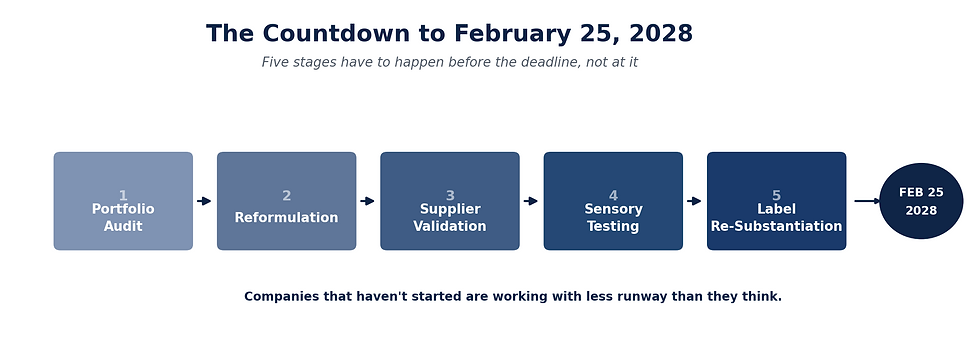
That's the labeling story. The staffing story is bigger. Most companies are underestimating how far this reaches: the biggest operational risk is successfully navigating the shifting regulatory landscape, and R&D teams face the daunting task of reformulating existing products to comply with new regulations while also providing a steady supply of the new ingredients required by consumers. 2028 feels far away until you count backward: portfolio audits, reformulation, supplier validation, sensory testing, and label re-substantiation all have to happen before the deadline, not at it. Companies that haven't already started are working with less runway than they think.
Why Sodium Reduction Food Scientist Recruiting Is So Hard Right Now
Sodium isn't just a flavor input. It is doing structural work in most reformulated products, which is exactly why cutting it is one of the hardest problems in food science. Sodium controls texture, preservation, and microbial safety in products like cheese and cured meats, and pulling it out without a plan for what replaces those functions creates real technical failure, not just a blander product. The barriers span consumer perception, microbiology, processing, and physicochemistry all at once. Sodium reduction is not a job for a generalist food scientist working from a spec sheet.
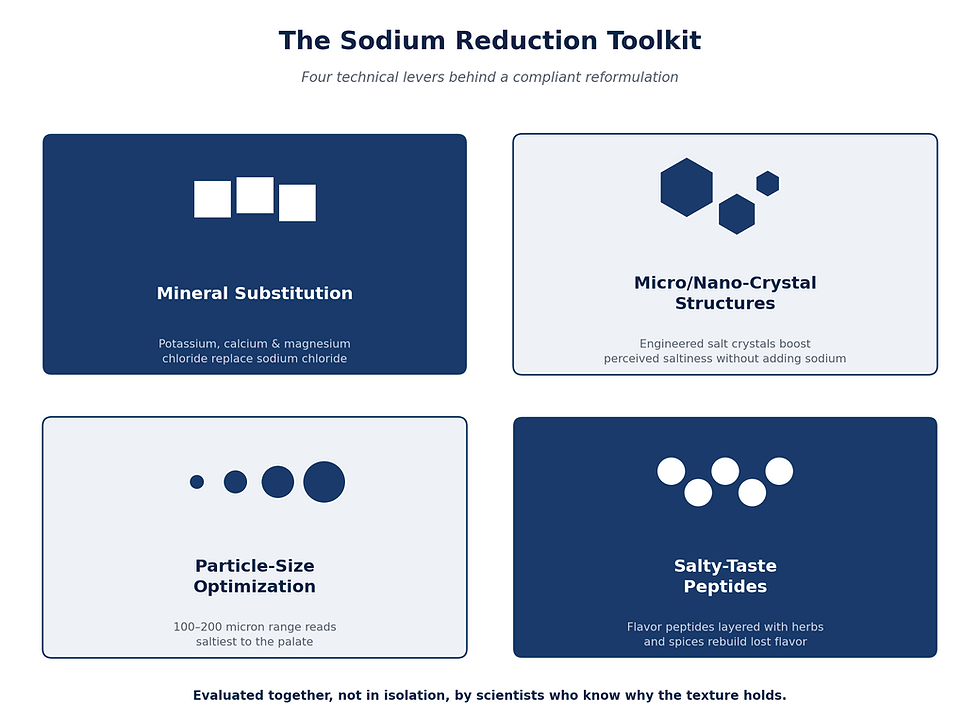
The scientists solving this problem well are working with a specific technical toolkit: partial substitution with potassium, calcium, or magnesium chloride; micro- and nano-crystal salt structures that boost perceived saltiness without adding sodium; particle-size optimization (the 100 to 200 micron range reads saltiest to the palate); and salty-taste-enhancing peptides layered with herbs and spices to rebuild flavor after sodium comes out. That's a narrow specialty. A sodium reduction food scientist recruiter has to be able to evaluate candidates on that exact toolkit, not on general "reduced-sodium product" experience, which usually means someone swapped an ingredient once and doesn't know why the texture held or didn't.
Sugar Reduction R&D Hiring Faces the Same Wall for Different Reasons
Sugar is arguably harder to remove than sodium, because it's doing more jobs at once: browning, binding, crisp and crunch, moisture retention, freezing-point depression, water activity, bulking, and shelf life all depend on it to some degree. Pull sugar out of a baked good and you don't just lose sweetness. You lose crumb structure, browning, and shelf stability all at once, which is why rebuilding bulk and texture is consistently the most complex part of any sugar-reduction project, whether it's bakery, dairy, or frozen desserts.
This is exactly why sugar reduction R&D hiring can't be treated as an extension of a company's existing formulation team. The scientists doing this work well are fluent in synergistic systems, layering low-calorie bulk sweeteners like erythritol or allulose with natural high-intensity sweeteners and flavor modulators to rebuild the mouthfeel and structure sugar used to provide. That's a specific, current skill set, not something every "Senior Food Scientist" on an internal team already has. Most companies discover the gap mid-project, when a reformulated product fails at the sensory panel or on the shelf, rather than before they start hiring for it.
Is Your Compliance Search Actually Built for This Deadline?
Ask yourself a few questions before you assume your current search process can handle this. Is the recruiter running this search able to name the difference between potassium chloride substitution and micro-crystal salt structuring, or are they forwarding you resumes that say "reduced sodium" and hoping the details work out? Has your candidate pipeline ever actually hit an external regulatory deadline before, or has it only ever worked against an internal innovation roadmap with no hard date attached? Are you sourcing from the same three job boards every generalist recruiter in the category is also posting to right now, competing for the same handful of active job-seekers? And critically: does your search account for the documentation this rule will have auditors checking, meaning labels, claims substantiation, and supplier specs, or is it treating this like any other formulation hire? If you answered "not sure" to more than one of those, your search isn't built for a compliance cliff. It's built for a normal hiring cycle, and February 25, 2028 isn't giving you a normal hiring cycle.
The candidates who can actually pass that test are not applying to job postings. They're already inside a competitor's reformulation program, quietly solving this exact problem, and reachable only through a recruiter who has the relationships to have that conversation directly.
The companies moving first aren't just protecting their launch timelines. They're locking in the compliant ingredients, supplier pricing, and regulatory certainty that get scarcer the closer the industry gets to 2028. As reformulation accelerates in response to the FDA's new "healthy" definition, demand for compliant ingredients is climbing fast, supplier power is shifting, ingredient costs are likely to increase, and lead times will stretch for manufacturers who delay. The same dynamic applies to talent. The sodium and sugar reduction specialists capable of doing this work well are a fixed, small pool, and every company racing the same deadline is competing for the same names.
What Closing the Gap Actually Looks Like
Closing this gap starts with evaluating candidates on real reduction work, not adjacent formulation experience. Sodium substitution systems, sugar bulking and flavor-modulation strategies, and sensory rebuild after nutrient removal are the actual bar, and a resume that only mentions "reduced-sodium" or "reduced-sugar" product lines in passing doesn't clear it. It also means sourcing passively, because the scientists who've actually solved these problems are already deep in a competitor's compliance program and are not responding to a generic "Food Scientist II" posting; reaching them takes a direct relationship, not a job board. And it means moving on a real timeline: portfolio audits, reformulation, supplier validation, and re-testing all have to be complete well before February 2028, which means the hiring has to happen now, not in 2027, when every other manufacturer in the category suddenly needs the same specialists at once.
People Capital was founded in 2007 and has worked exclusively in food, beverage, ingredient, flavor, nutraceutical, chemical, agriculture, and pet food ever since. That means we've been tracking FDA labeling and compliance rules, and the scientists who solve for them, longer than most internal TA teams have existed. That regulatory-timeline fluency is exactly what a compliance-driven search like this one requires: knowing not just who the sodium and sugar reduction specialists are, but which ones have actually worked against a hard external deadline before. It's also why one of the largest food and beverage CPG companies in the world, with 52 people on its own internal talent acquisition team, still calls People Capital every year to fill Research and Development, Quality, Regulatory, Food Safety, and Flavorist roles. Fifty-two in-house recruiters is a serious internal engine, and it still isn't always fast enough when a hiring manager needs a critical, technical role filled now. That's the gap we close, and it's why they keep coming back. Our typical search runs under six weeks, because cultural fit, work style, and technical depth are verified before a candidate is ever presented, not after.
The Bottom Line on the FDA 2028 Compliance Cliff
The 2028 deadline isn't a distant labeling update. It is a fixed date that every "healthy"-claiming manufacturer in the category is racing toward with the same thin bench of sodium and sugar reduction specialists. Unlike the traceability deadline hitting your plant floor the same year, this one determines whether your product can keep the claim on the front of the package at all. The companies that hit February 25, 2028 with a full, compliant product lineup won't be the ones with the biggest R&D budgets. They'll be the ones who staffed the reformulation work in 2026 and 2027, while the bench was still open.
This is one of four fault lines converging on food and beverage R&D benches right now. Read the full strategy for staffing ahead of all of them: Next-Gen Formulation Sourcing & R&D Strategy
Two 2028 deadlines are converging on your organization from opposite directions. Don't staff for just one of them.


Comments